

While SENHO provides comprehensive installation guidance services, facility managers and experienced technicians may choose to perform the installation independently to optimize project timelines and labor costs.
However, industrial chiller installation requires more than simply connecting power and water. Proper planning and attention to detail during the initial setup are critical. A rigorous installation process not only ensures optimal cooling performance but also significantly extends the service life of your equipment.
Before proceeding with the installation, please thoroughly review the following foundational guidelines:
1. Installation Site Selection
Choosing the right location is the first step toward efficient heat dissipation and accessible maintenance.
Air-Cooled Chillers
Air-cooled units require open spaces with excellent ventilation.
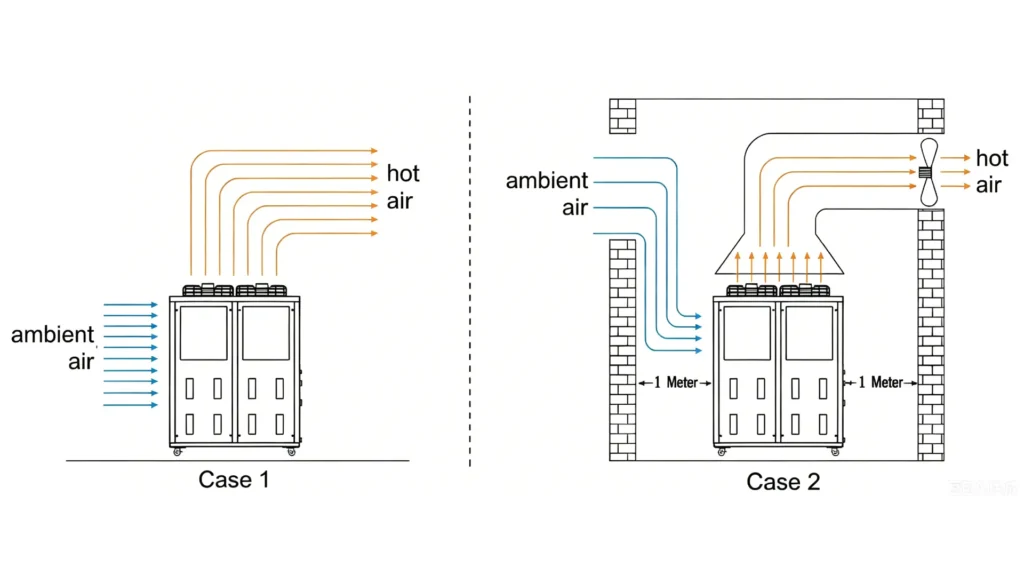
- Clearance Requirements: Maintain a minimum clearance of 1 meter around all sides of the chiller. Obstructions or walls within this radius will impede airflow, causing the exhausted heat to recirculate and severely diminishing cooling capacity.
- Ventilation Solutions: The primary goal is to ensure heat is effectively expelled from the operating environment. If the chiller must be installed in a poorly ventilated indoor space, you must consider mounting an exhaust air duct above the condenser fans to direct hot air outside. (Reference Diagram: Case 1 illustrates optimal drafty conditions; Case 2 demonstrates a restricted environment requiring ductwork.)
Water-Cooled Chillers
Since water-cooled chillers reject heat through a cooling tower rather than ambient air, ventilation is less critical. The primary site requirement is reserving adequate physical space around the unit to facilitate future maintenance and routine inspections.
2. Foundation and Leveling Requirements
Industrial chillers vibrate during operation. Placing the unit on an uneven or structurally weak surface will amplify these vibrations, potentially leading to mechanical failure over time.
- General Requirement: The chiller must be placed on a solid, load-bearing concrete floor. The surface levelness must be strictly controlled within 6mm. This is especially crucial for portable chillers equipped with castors to prevent displacement.
- Large Units (Models > CRA/CRW60): A dedicated concrete foundation is mandatory.
- Construct a 50-100mm vibration-absorbing gap (filled with sand or pitch) around the foundation’s perimeter.
- Ensure pre-drilled bolt holes are present to securely anchor the chiller base to the foundation.
- Leveling Procedure: Once the chiller is positioned, use a precision level meter to check for any inclination. If leveling is required, insert steel parallel shims between the chiller base and the concrete foundation until perfectly horizontal.
3. Electrical and Piping Specifications
Avoid undersized wiring or piping, which can cause system bottlenecks or electrical hazards. Always refer to the specific SENHO Chiller Specification Sheet provided with your unit. Use the documented connection sizes and maximum amperage (Max Amps) ratings to correctly select your external water pipes and electrical cables.
4. Filtration System Installation
Protecting the chiller’s internal water circuit from impurities is vital, particularly if the facility’s water quality is unverified.
- Evaporator Inlet: Filtration is highly recommended.
- Small Units (Below PRA/PRW10): Cup-type filters are generally sufficient.
- Large Units: Industrial Y-type strainers are strongly suggested for better flow capacity and durability.
- Condenser Inlet (Water-Cooled Units): It is mandatory to install a filtration system at the condenser inlet. Cooling tower water is exposed to the open air and frequently contains foreign matter and scale. Select a proper filtration system tailored to your specific water conditions.
5. System Piping and Pump Positioning
Correct piping logic directly impacts system pressure and flow rates. Always verify connections against SENHO’s instructional diagrams.
- Port Identification: Double-check the clearly marked “INLET” and “OUTLET” signs on your SENHO chiller before making any connections.
- Pump Placement: In a cooling circuit, the water pump should always draw water from the source (the component holding the largest volume of water, such as an external water tank or cooling tower basin).
- Pump Elevation: Unless utilizing a self-priming pump, ensure the pump is positioned at a lower elevation than the water level in the source container to prevent idling and cavitation.
- Isolation Valves: Install heavy-duty shut-off valves on both sides of every major component (Chiller, Pump, Water Tank). This allows you to isolate equipment for maintenance without draining the entire system and spilling treated water.
- Pressure Monitoring: Install water pressure gauges across the circuit. Monitoring pressure differentials is the most effective way to quickly diagnose blockages or leaks within the system.
6. Vibration Isolation
For medium to large-scale cooling projects, minimizing transmitted vibration protects the integrity of your piping infrastructure.
- Flexible Joints: Install flexible rubber or stainless steel joints on both the inlet and outlet sides of any device containing an electric motor (chillers, pumps). This absorbs operational vibrations, reduces noise, and prevents pipe fatigue/leakage.
- Independent Support: Water pipes must be secured on rigid, independent supports or hangers. The piping weight should never rest on the chiller’s connections or the pump casing.
7. Consideration for Future Maintenance
Proactive maintenance planning during installation saves significant downtime later.
- In addition to reserving adequate physical clearance and installing isolation valves, consider mounting overhead assistant devices, such as a hanging rail or gantry setup, to facilitate the safe removal of heavy components (like compressors) during major overhauls.
Need Professional Assistance? If you encounter any uncertainties while planning or executing your installation, the SENHO technical support team is always at your service. Please reach out to us for authorized guidance to ensure your system is set up for maximum efficiency and reliability.