

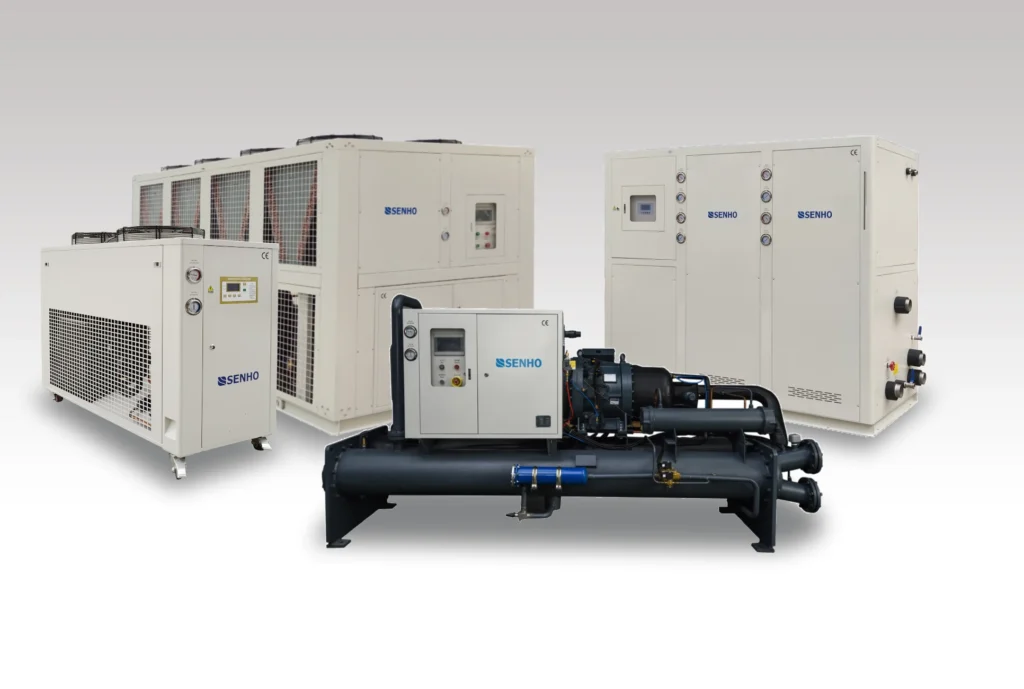
“I have several machines in my facility that need to be cooled. Should I use one dedicated packaged chiller for each machine, or invest in one central chiller for the entire plant?”
At SENHO, our engineering team is asked this question constantly. The truth is, there is no one-size-fits-all answer. The right choice depends on your specific production processes, facility layout, budget, and long-term goals. Making the correct decision will not only impact your initial capital investment but will also significantly affect your ongoing operational costs and production efficiency.
Before making a decision, you need to evaluate the following primary considerations.
1. The Dealbreakers: Temperature and Space
Before looking at costs, you must determine if a central system is even feasible for your specific process.
- Varying Temperature Requirements: Do all of your machines require the exact same cooling temperature? For example, if Machine A needs 15℃ water for precision molding, but Machine B needs 20℃ water for general hydraulic cooling, a central chiller is likely not the proper choice. A central system provides a single set-point temperature to all usage spots. While complex control valves can theoretically regulate localized temperatures, it is inefficient and rarely as convenient or precise as using dedicated packaged chillers.
- Facility Space and Working Environment: Is there enough floor space to locate a chiller unit directly next to your machine? Point-of-use packaged chillers require footprint space on the production floor. Furthermore, air-cooled packaged chillers will reject heat and generate noise inside your factory. If your indoor space is strictly limited or you need a quiet, temperature-controlled production floor, a central chiller is the better option. Central units can be located far away in dedicated utility rooms or even outdoors.
2. Scalability and Installation
- Future Expansion: If your factory is growing rapidly and you plan to add machines one by one over the next few years, individual packaged chillers offer ultimate flexibility. You simply buy a new chiller when you buy a new machine. A central system requires you to accurately forecast your future cooling loads and invest in a larger capacity unit upfront.
- Installation Complexity: Packaged chillers are essentially “plug-and-play,” as the compressor, condenser, evaporator, and pump are all integrated into one unit. You move them into position, connect the hoses, and turn them on. Central cooling systems require extensive infrastructure, including insulated piping routed throughout the factory, centralized pumping stations, and complex installation labor.
3. Maintenance vs. Reliability (The Risk Factor)
When comparing the two systems, maintenance and production reliability present a distinct trade-off.
- Routine Maintenance: For daily and monthly maintenance, a central chiller is far more convenient. Your maintenance team only needs to check the refrigerant levels, clean the condenser, and manage the water quality for one large unit. With multiple packaged chillers, you must individually service every single unit scattered across your factory, which significantly increases manual labor costs.
- Redundancy and Downtime Risk: What happens if the chiller breaks down? If a single packaged chiller malfunctions, only the specific machine attached to it goes down; the rest of your factory keeps running. However, if a central chiller goes offline, it paralyzes every production process relying on that cooling loop. Therefore, if you choose a central cooling system, it is absolutely critical to invest in a backup unit (an N+1 redundancy setup) to prevent catastrophic factory downtime.
4. Running Costs and Energy Efficiency
In the long run, energy consumption is the largest expense of any chiller system. Here, central systems typically have the upper hand.
- Thermal Mass and Compressor Cycling: We generally design central cooling systems with significantly larger external water reservoirs. A large volume of water creates “thermal mass,” meaning the temperature changes very slowly. Because a chiller automatically starts and stops based on the water temperature it detects, this large reservoir keeps the system highly stable and drastically reduces the number of times the compressor needs to cycle on and off.
- Energy Consumption at Startup: Conversely, standalone packaged chillers usually have smaller built-in water tanks due to unit dimension limits. Returning warm process water quickly raises the tank’s temperature, causing the compressor to start and stop frequently. Because an electric motor draws its maximum power consumption at the exact moment it starts, this frequent cycling leads to higher energy waste. A properly sized central cooling system will run much more smoothly and be far more energy-efficient than a fleet of individual packaged chillers.
Summary Comparison Table
| Feature | Packaged Chillers (Point-of-Use) | Central Chiller System |
| Temperature Control | Independent, precise control per machine | Single temperature for the whole plant |
| Installation | Quick, plug-and-play | Complex, requires extensive piping |
| Floor Space | Takes up space next to production machines | Frees up production space (can be outdoors) |
| Maintenance Labor | High (multiple units to service) | Low (only one main system to service) |
| Downtime Risk | Localized (only one machine affected) | High (entire plant affected without backup) |
| Energy Efficiency | Lower (frequent compressor cycling) | Higher (stable operation, fewer startups) |
Conclusion
Have you made your decision after evaluating these factors? If you need precise, varied temperatures and want a scalable, plug-and-play solution, dedicated packaged chillers are the way to go. If you want maximum energy efficiency, simplified maintenance, and a cleaner production floor, a central chiller system (with a proper backup) is your best investment.
Still unsure which configuration is right for your facility?
Designing the perfect industrial cooling loop requires expert calculations. Feel free to contact us at any time. The engineering team at SENHO is always pleased to evaluate your site and design a custom cooling solution tailored to your exact needs.