

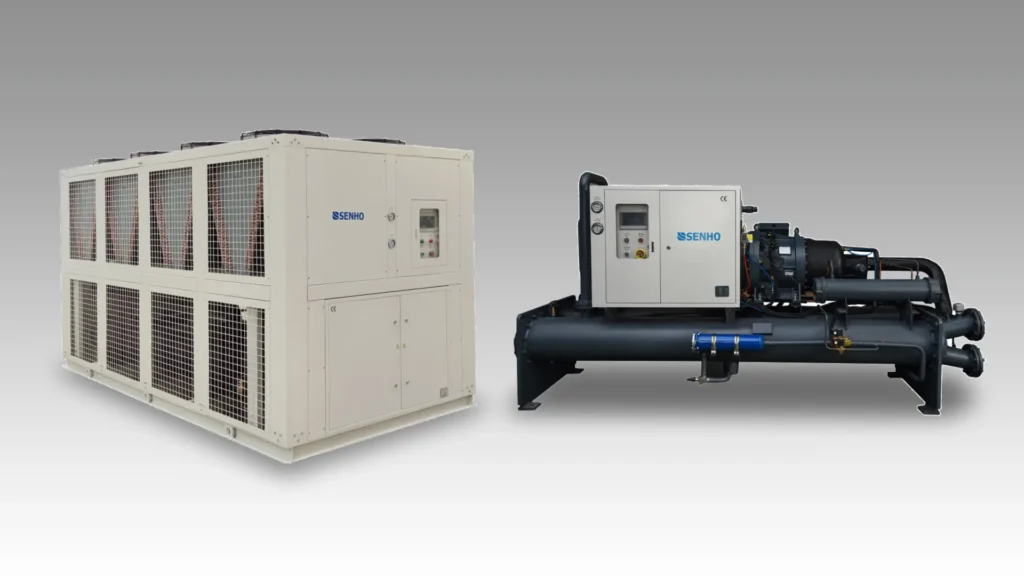
Choosing between an air-cooled and a water-cooled chiller is a common dilemma for industrial plant managers and engineers. While both systems effectively manage temperature, they operate differently and suit different operational environments.
To help you make the best decision for your project, we compare these two systems based on performance, installation requirements, maintenance, and total cost of ownership.
1. Performance: The Physics of Cooling
The primary difference lies in how heat is rejected from the system.
- Air-Cooled Chillers: Use an aluminum fin-type condenser to discharge heat directly into the ambient air.
- Water-Cooled Chillers: Utilize a shell-and-tube condenser, where heat is removed by circulating water.
Why Water-Cooled Often Performs Better: Water has a higher specific heat capacity and a lower temperature than ambient air. Because water-cooled systems can achieve a lower condensing temperature, they generally offer superior cooling performance compared to air-cooled models of the same size.
2. Installation: Space and Infrastructure
- Ventilation: Air-cooled units require an open, drafty area to prevent hot air recirculation, which can lower efficiency or trigger a shutdown. Water-cooled units have no such strict ventilation requirements.
- Footprint: Air-cooled condensers are physically larger to compensate for air’s lower heat transfer efficiency. Water-cooled systems are more compact but require additional infrastructure.
- Complexity: Air-cooled chillers only require piping to the load. Water-cooled systems require a more complex setup, including the installation of a cooling tower and piping between the tower and the chiller condenser.
3. Maintenance: Ease of Care
- Air-Cooled: Dust accumulation on the condenser is visible and easy to spot. Cleaning is straightforward—simply remove the debris with water and non-corrosive additives.
- Water-Cooled: The condenser is a closed system, making it difficult to inspect for fouling. Cleaning requires specialized professional equipment and is generally less convenient.
4. Total Cost of Ownership (TCO)
While air-cooled chillers typically have a higher initial unit cost, the comparison is not straightforward.
- Hidden Costs: Water-cooled chillers require the extra investment of a cooling tower, which closes the initial price gap.
- Long-term Costs: Air-cooled chillers hold a clear advantage regarding maintenance costs due to their simplicity and ease of cleaning.
Summary: Which One to Choose?
Both systems have distinct advantages.
If your facility has limited space for infrastructure and you prioritize low-maintenance operations, an air-cooled chiller is often the better choice.
If your project demands high cooling efficiency and you have the space for a cooling tower, a water-cooled chiller may be more effective. If you If you are planning to install a large chiller unit indoors water-cooled chiller will be the best option.
Still unsure which system fits your specific requirements?
Our engineering team is here to help. Contact us today to get a professional recommendation tailored to your project.