

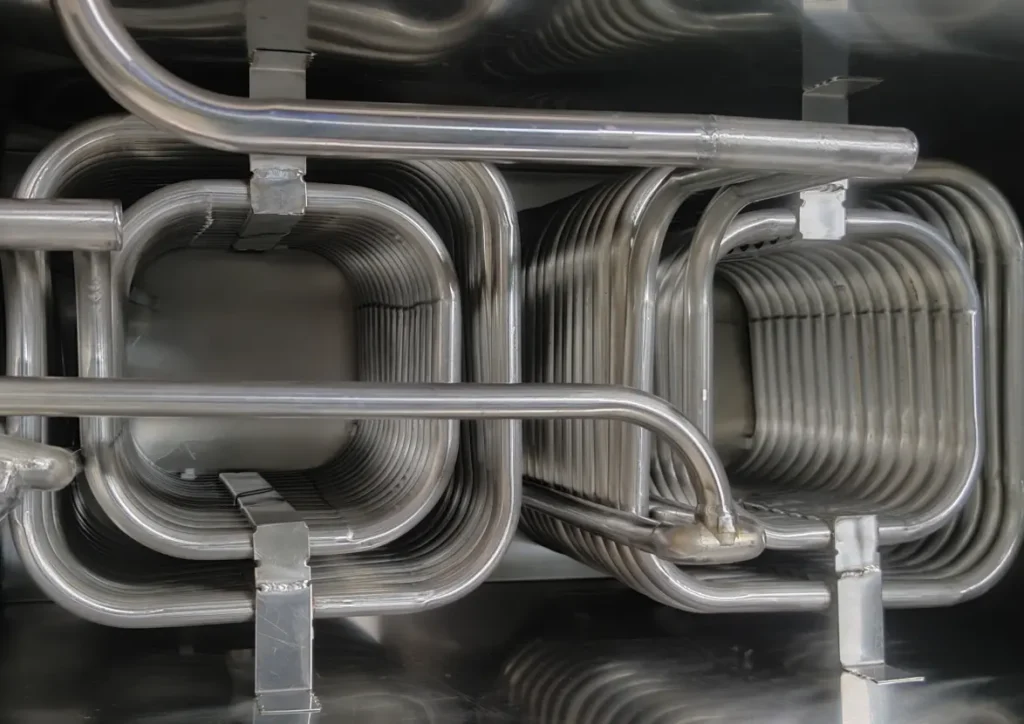
The evaporator is a critical component in any industrial chiller system. Its primary function is to act as the heat exchange hub, transferring cooling energy from the cold refrigerant gas to the process water or coolant. Choosing the right type of evaporator directly impacts your chiller’s efficiency, lifespan, and maintenance requirements.
In the industrial cooling sector, there are three main types of evaporators: Coil type, Shell and Tube type, and Plate type. Below, we compare these three designs across four crucial aspects: Heat Transfer Efficiency, Maintenance Convenience, Water Quality Requirements, and Space Occupation.
1. Heat Transfer Efficiency
Heat transfer efficiency is the most vital performance metric for a heat exchanger. Higher efficiency means the system can transfer more thermal energy using a smaller heat exchange area, reducing energy consumption.
- Plate Type (Highest Efficiency): Plate evaporators utilize a series of corrugated metal plates compressed together. This precise structure creates a highly turbulent flow, maximizing the contact area between the refrigerant and the coolant, resulting in superior heat transfer rates.
- Shell and Tube Type (Moderate Efficiency): Ranking second, this design pumps water through a bundle of tubes enclosed within a large cylindrical shell containing the refrigerant. Internal baffles help direct flow, offering reliable and steady heat exchange.
- Coil Type (Lowest Basic Efficiency): Generally, a standard coil type has the lowest efficiency among the three. Because it relies on simple immersion, it inherently requires a significantly larger heat exchange area to achieve the same cooling capacity as its counterparts. (Note: See the SENHO Standard below on how premium manufacturers overcome this).
2. Convenience of Maintenance
Regular maintenance is essential for keeping a chiller running at peak performance. The structure of the evaporator dictates how easily it can be cleaned or repaired.
- Coil Type (Most Convenient): Featuring the simplest design, coil evaporators are normally submerged directly inside a water tank equipped with a removable cover. This makes visual inspections, mechanical brushing, and tank cleaning incredibly straightforward.
- Shell and Tube Type (Moderately Convenient): To clean this evaporator, technicians must unbolt and remove the heavy end covers (water boxes) to access the internal tube bundle. While it allows for thorough mechanical tube cleaning, the process is labor-intensive and requires dedicated maintenance clearance.
- Plate Type (Least Convenient): Plate evaporators offer the poorest maintainability. Because the internal water channels are highly complex and tightly compressed, manual disassembly is incredibly difficult, and many brazed plate evaporators are entirely non-detachable. Maintenance relies heavily on regular chemical flushing (Clean-in-Place systems) rather than physical scrubbing.
3. Requirement for Water Quality & Corrosion Resistance
The physical design of the water channels determines how susceptible the evaporator is to clogging from debris, scale, or biological growth.
- Plate Type (Strict Requirements): Due to its exceptionally narrow internal water runners, plate evaporators demand the highest water quality. They are easily jammed by fine foreign substances, making high-mesh Y-strainers and strict water treatment protocols mandatory.
- Shell and Tube Type (Moderate Requirements): The wider tube diameters allow this type to handle moderate impurities better than plate designs, but excessive scale buildup will still insulate the tubes and ruin efficiency.
- Coil Type (Flexible & Highly Durable): Thanks to its open-tank immersion design and robust structure, the coil evaporator can handle relatively poor water quality and particulate matter without immediate risk of clogging. More importantly, premium industrial coils utilize SUS304 stainless steel rather than traditional copper.
- The SUS304 Advantage for Ultimate Durability: SUS304 stainless steel offers exceptional, heavy-duty resistance to rust, oxidation, and chemical corrosion. This high structural durability prevents tube degradation and water contamination, making it highly suitable for harsh industrial environments or industries with strict hygiene requirements (like food, beverage, and medical packaging). It significantly extends the operational lifespan of the evaporator, ensuring years of trouble-free operation.
4. Space Occupation and Chiller Footprint
Space occupation refers to how the evaporator impacts the overall physical footprint and internal layout of the chiller unit. Smaller internal components leave more room for routine maintenance access.
- Coil Type (Most Compact for Assembly): Because the SUS304 coil is built directly into the water tank, it requires virtually zero additional space within the chiller frame. While the physical coil displaces some water volume in the reservoir, it remains the most space-saving configuration for the overall machine assembly.
- Plate Type (Compact, but External): While the plate heat exchanger itself has the smallest physical dimensions due to its precise structure, it is mounted externally to the water tank. Therefore, it occupies its own dedicated footprint inside the chiller cabinet.
- Shell and Tube Type (Largest Footprint): This type requires the most space. Although it holds a small reserve of water within its shell, the volume is usually insufficient for stable industrial cooling circuits, meaning a separate water tank is still required. Furthermore, its horizontal orientation stretches the chiller’s footprint, making it the least compact option.
Assembly Space Ranking: Coil Type < Plate Type < Shell and Tube Type
Conclusion: The SENHO Standard
Selecting the correct evaporator is a balancing act between budget, efficiency, space constraints, and site-specific water conditions.
At SENHO, we prioritize equipment longevity, reliability, and cooling performance. That is why all SENHO packaged chillers come standard with a built-in SUS304 stainless steel coil evaporator. By moving beyond traditional copper, our chillers deliver unmatched durability, superior corrosion resistance, and cleaner water circulation for a much longer service life.
Furthermore, we have engineered a solution to the traditional efficiency limits of standard coil designs. SENHO specially designs our SUS304 coil evaporators with an increased number of heat exchange tubes. This structural upgrade significantly enlarges the total heat exchange surface area, guaranteeing full, highly efficient thermal transfer.
With a SENHO packaged chiller, you get the absolute best of both worlds: the rugged durability and easy maintenance of a coil evaporator, paired with the optimized, high-efficiency cooling performance your production demands.